It remembers. And its reliability is measured.
An Easycore agent keeps the memory of your work from one session to the next. Every six hours, its behaviour is scored by code, never by the agent itself. Here are both, in detail.
Memory, in three stages.
Raw sessions become sorted knowledge: retained, consolidated, then recalled at the right moment.
Retain
At the end of each session, useful facts are extracted: preferences, decisions, context. Every hour, raw sessions are summarised by plain parsing, with no model call. Twice a day, the agent writes a structured reflection on how it works.
Consolidate
Every five exchanges, people, decisions, tasks and facts are extracted. The index of memory files is resynchronised on every change and every hour. Every Sunday at 10 pm, a curation pass sorts the memory: deletion, merging, invalidation of outdated facts, separation of conflated entities; every decision is logged. After a complex task (three tool calls or more), the agent turns it into a skill, validated before it is written.
Recall
On every message, four indexes are queried in parallel: a hybrid keyword and semantic search, a fact memory, a dated knowledge graph where an outdated fact is invalidated rather than deleted, and a fallback semantic index. Long sessions are compacted on three levels so the thread is never lost.
Every memory is ranked before it enters the context.
Every candidate memory is ranked before it enters the context: agreement between the four sources, closeness to the question, recency and the reliability of where it came from.
Reading is local.
The four sources are merged on the client's machine: deduplication, ranking by score, bounded volume. No third-party model reads your memories to recall them.
It learns procedures too.
When a sequence of work succeeds, the agent can write it up as a skill: when to use it, procedure, pitfalls, verification. A validator checks the format and blocks duplicates; the content only loads when it is needed.
Your memory stays yours: specific to each agent, on its machine, returned at the end of the contract (DORA reversibility).

The trust score, method included.
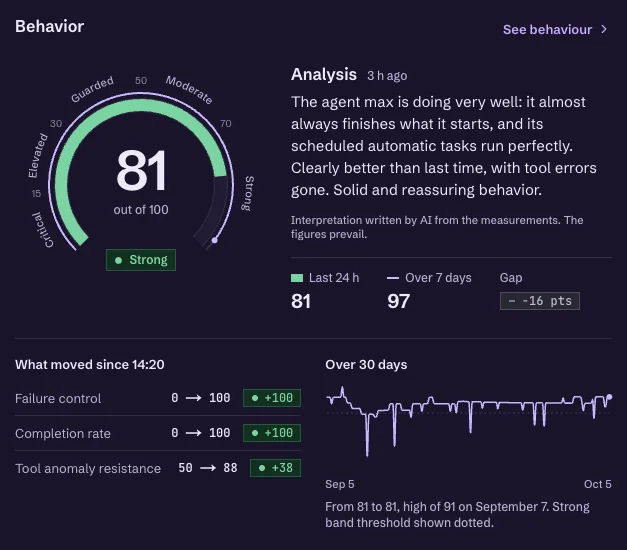
The score does not rely on what the agent says about itself. It is calculated by code from the agent's real sessions, then completed by Easycore's trust service, separate from the agent, which adds the integrity of its audit chain.
| Dimension | What it measures | Coefficient |
|---|---|---|
| Raise the score | ||
| Completion rate | Share of sessions completed without being aborted or hitting excessive errors (more than 30% of tool calls failing). | 0.30 |
| Cron reliability | Share of scheduled tasks run without excessive errors. | 0.20 |
| Consistency | Regularity of the number of tool calls from one session to the next, for the same type of work. | 0.15 |
| Measured as risks, lower the score | ||
| Failure control | Share of sessions aborted or with excessive errors. | 0.15 |
| Stability | Variability of session duration, for the same type of work. | 0.08 |
| Tool anomaly resistance | Deviation between the tools used and the agent's usual profile. | 0.07 |
| Response time stability | Increase in median response time between the first and second half of the period. | 0.05 |
| Added by the trust service | ||
| Audit chain integrity | Chain continuity: each sealed event is correctly linked to the previous one. | 0.10 |
The calculation.
Every six hours, sessions from the last 24 hours and the last 7 days are analysed. Each dimension is a number between 0 and 1.
Agent score, bounded between 0 and 1:
(0.30 × completion + 0.20 × scheduled tasks + 0.15 × consistency) / 0.65 − (0.15 × failures + 0.08 × volatility + 0.07 × tool anomalies + 0.05 × response time drift) / 0.35Final score, completed by the trust service:
0.90 × agent score + 0.10 × audit chain integrityWith no sealed event in the period, the agent score is carried over as is.
The cockpit shows the score out of 100 with its history. Risks are shown the right way up: 100 minus the measured risk.